


Spatial epidemiology of Chagas disease in Chile: estimating the epidemiological risk from eco-epidemiological and incidencebased risk maps
Chagas disease is a zoonotic disease produced by the haemoflagelate protozoa Trypanosoma cruzi (Kinetoplastida), transmitted by reduvidean insects (Hemiptera). The infection can be acquired by contact with infected triatomine dejections, blood transfusion, organ transplantation, oral route, congenital transmission and by laboratory accidents. The primordial mechanisms of transmission directly related to the enzootic cycle, such as the one caused by vectors outside the homes, or by sporadic entrance of vectors into houses as well as the oral transmission route begin to become relevant in the generation of newinfections by T. cruzi. This is a vector-borne disease of great impact in Latin-America, with an estimated 16–18 million human incidences and 45 000 deaths annually in this region.In countries in which this disease did not exist in past decades, such as the U.S.A., now there are estimations between 300 thousand and 1 million persons infected. Although in Chile and in Latin-America there are a large number of studies of Chagas´s diseases from the medical and veterinary perspective and also many studies about the ecology of the insect vectors, a full understanding of the etiology and epidemiology of Chagas disease across its geographical distribution has proven to be elusive and complex, and remains under intense investigation to the present day.
We intend to address the question of how the spatial distribution of insect vectors is related to the human risk of Chagas disease. In particular, we want to investigate the spatial, demographical and epidemiological characteristics of triatomine foci, and their relation to the entomological parameters that determine the reproductive number (R0) and the incidence of this disease. Based on the following: i) That the main manner of acquiring Chagas disease in the 1980s and 1990s was by vectorial transmission, ii) That the incidence in adults age 20 or more is a measure of their probability of exposition to the vector in years equivalent to their ages, iii) That beginning in 1999 the transmission chain was interrupted, and iv) That therefore the representation of exposed individuals and the number of years in which they were exposed to the vectors has decreased in the years 2005-2016 (the period to be analyzed); We want to investigate whether the distribution maps of the vectors are good proxies of eco-epidemiological maps (R0- maps) and incidence based risk maps and we propose the following hypothesis: The risk maps based on incidence between 2005 and 2016 will not be equivalent, and will be different than ecological maps based on the distribution of vectors and R0 maps, since there should have been a change from a predominantly vectorial transmission to a congenital one and the latter has less relation to the distribution of vectors due to the effect of migrations from high risk to low risk zones. We also propose that risk maps based on incidence will become increasingly different from ecological and R0 maps over the period 2007-2016. To construct R0-maps based on entomological and epidemiological parameters from model analyses, and incidence-based Risk maps for the Chagas disease in the rizk zone of Chile we will 1) analyze the Chagas disease dynamics models determining R0 using the next-generation matrix method 2) analyze and estimate the population parameters included in R0 for the different models 3)construct R0-maps from the expressions derived for each model analyzed 4) analyze the spatial and temporal behavior of the incidence of Chagas disease from 2005 to 2016 5) construct an incidence-based risk map for the Chagas disease in the risk zone by means of Bayesian models, from 2005 to 2016 and 6) compare the different maps obtained and with previously obtained ecological maps based on vector distribution.
Resultados iniciales
Modelando la transición de la Enfermedad de Chagas: desde transmisión vectorial a congénita
Mauricio Canals1,2, Dante Cáceres1, Sergio Alvarado1, Luis Gutierrez1, Andrea Canals1 & Pedro E. Cattan3.
1.- Programa de Salud Ambiental, Escuela de Salud Pública, Facultad de Medicina, Universidad de Chile.
2.- Departamento de Medicina, Facultad de Medicina, Universidad de Chile. E-mail: Esta dirección de correo electrónico está siendo protegida contra los robots de spam. Necesita tener JavaScript habilitado para poder verlo.
3.- Departamento de Ciencias Biológicas Animales, Facultad de Ciencias Veterinarias y Pecuarias, Universidad de Chile.
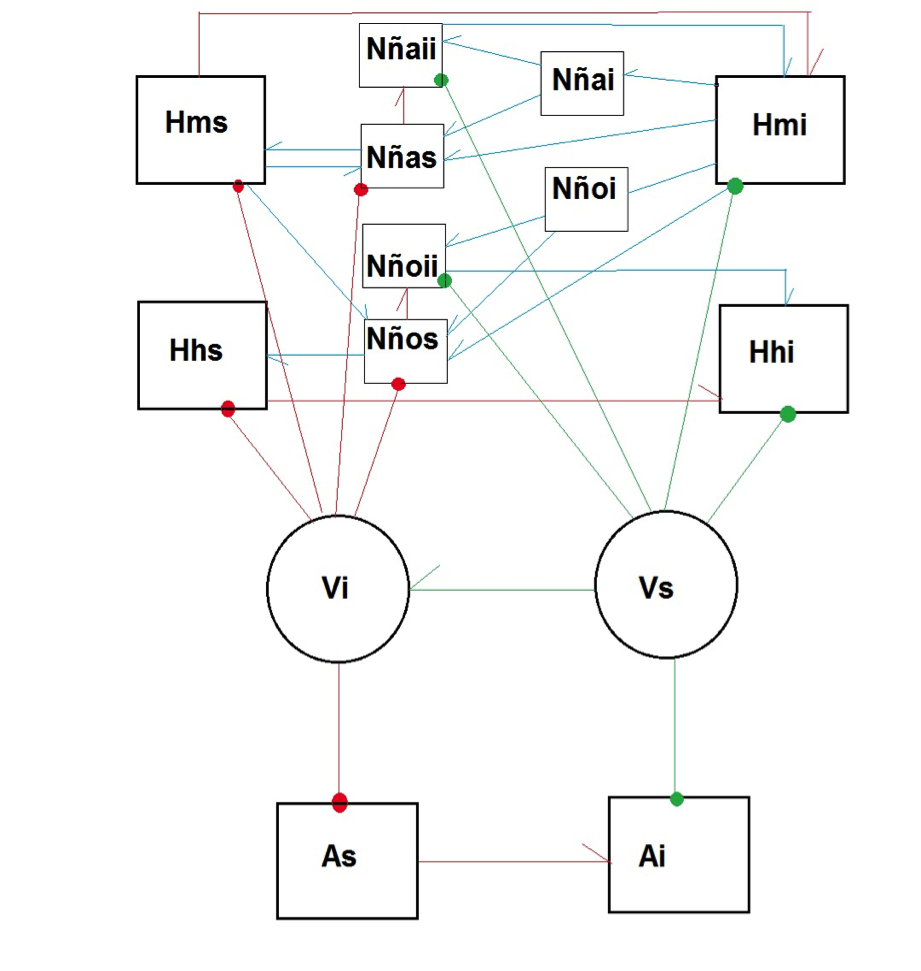
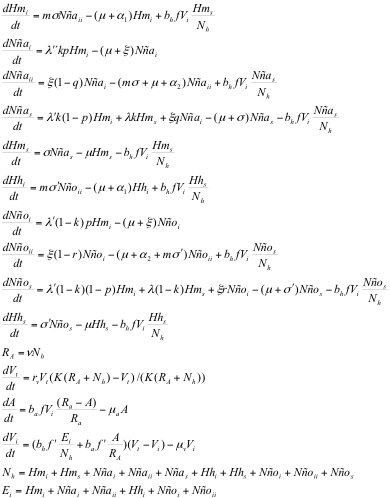
La enfermedad de Chagas sigue siendo altamente prevalente en Chile, especialmente entre las regiones de Arica y Parinacota y de Coquimbo, con una incidencia de alrededor de 11/100000habs y una mortalidad de 0,3-0,4/100000habs. Desde 1999 se considera que en Chile se encuentra interrumpida la transmisión vectorial. Bajo esta premisa, la dinámica epidemiológica y los mapas de riesgo de esta enfermedad se debieran estar modificando. En el marco de un proyecto que pretende analizar la dinámica de la enfermedad de Chagas y construir mapas de riesgo de la enfermedad constatando el cambio desde una transmisión vectorial a congénita, en este trabajo modelamos preliminarmente la dinámica epidemiológica de esta enfermedad. Basados en los modelos previos de Canals & Cattan (1992) de transmisión vectorial y de Raimundo et al. (2010) de transmisión congénita, proponemos un modelo que incluye ambas formas de transmisión y realizamos simulaciones. Mostramos que la transmisión congénita es “alimentada” por la transmisión vectorial y que sin ésta la enfermedad de Chagas congénita debiera decrecer exponencialmente hasta desaparecer. Así de no existir transmisión vertical desde hace más de 15 años, no debieran existir seropositivos menores que esa edad y no debieran producirse casos congénitos o ser muy escasos. El decrecimiento del Chagas congénito dependerá de un parámetro relacionado con la tasa de mortalidad, la edad en que las mujeres comienzan su actividad sexual, la proporción de mujeres y la proporción de niños tratados precozmente.
|
|
|
|
|
|
|
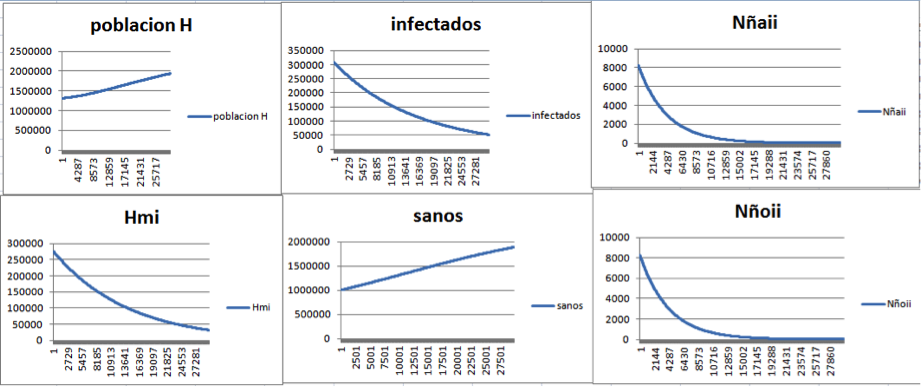
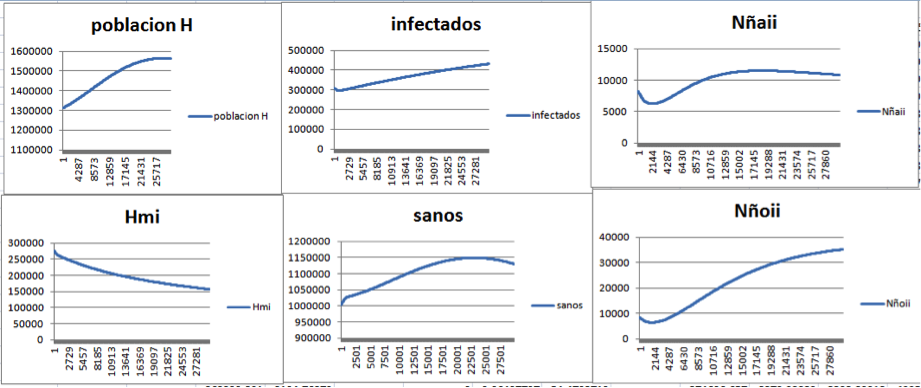 Figura 4: